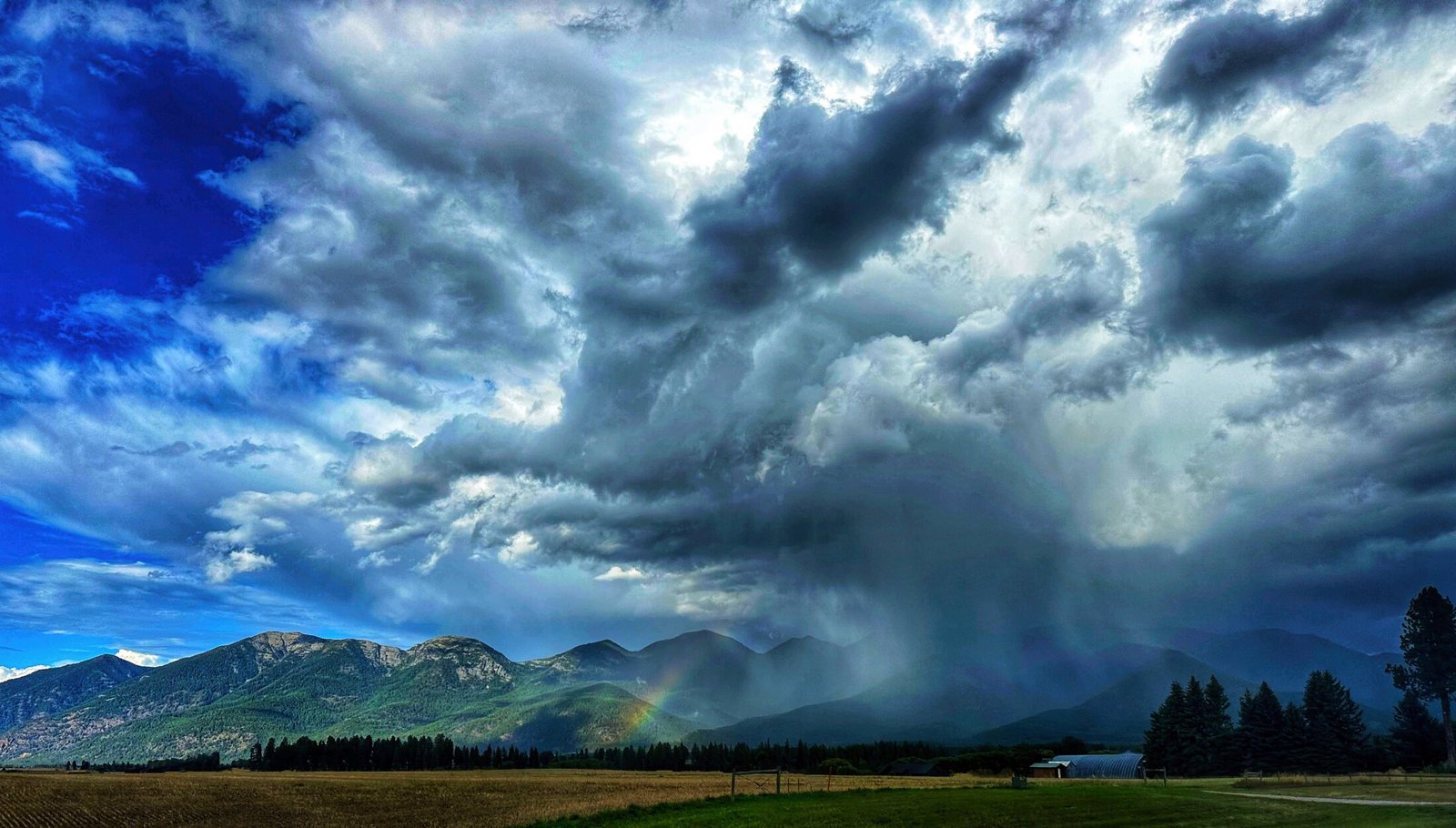
A limited-edition fine art photograph by Jordan Moore, preserving the threshold where storm, mountain, rain, and light gather into a moment of recognition before certainty.
MONUMENTAL EDITIONS AVAILABLE
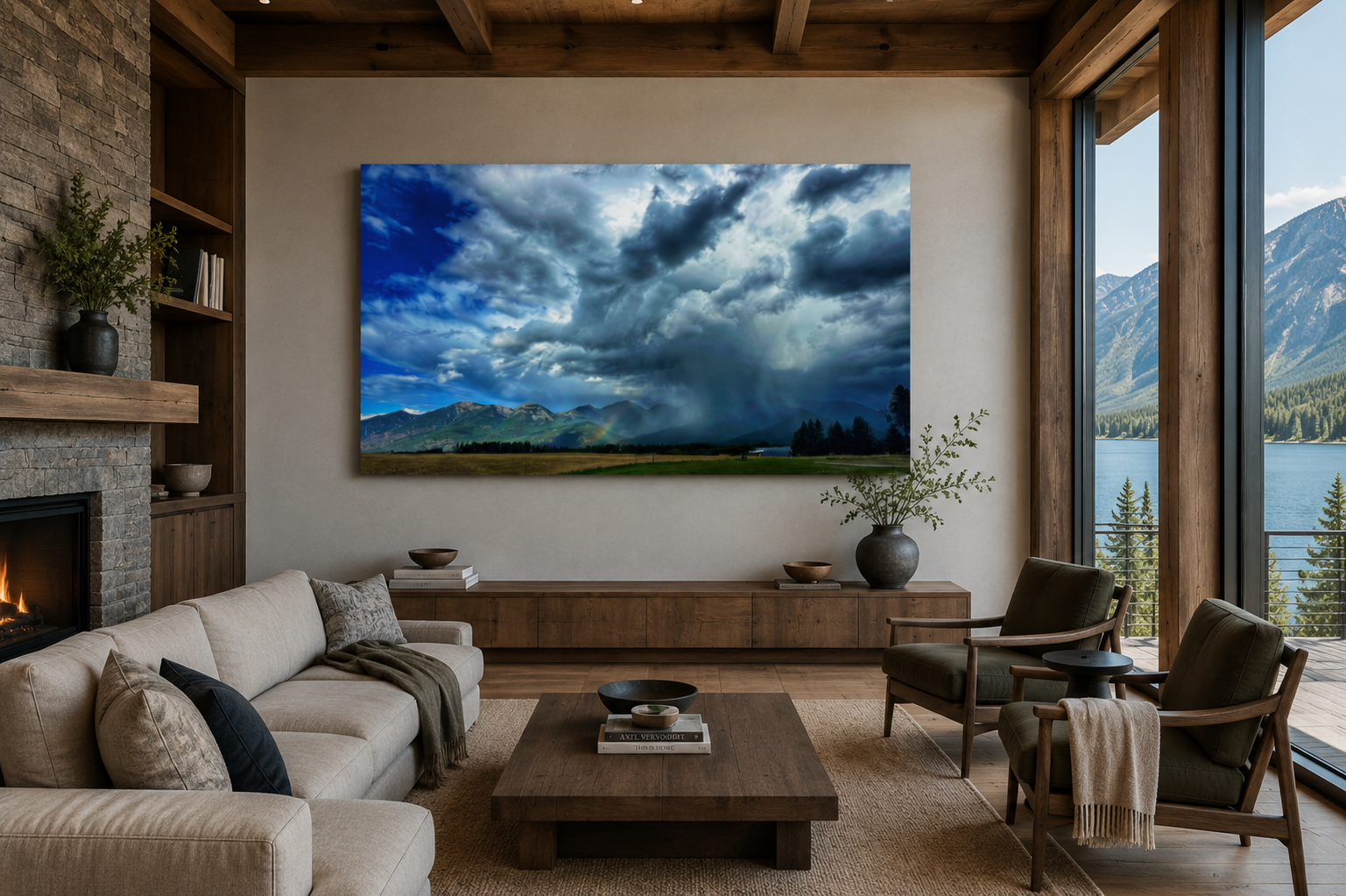
See how this work could live in your space. Preview it in a curated interior or use a photo of your own room to explore placement, proportion, and presence.
There are times when the world holds itself differently. Nothing has changed yet, and still, something has already begun.
In Where Weather Became Light, storm clouds gather over the mountains while rain descends across the valley and light presses through the weather beneath them. The landscape is not simply receiving a storm. It is standing inside the moment before weather fully declares what it will become.
That was the lesson hidden inside the scene.
For a long time, attention meant anticipation—watching the horizon, reading the clouds, trying to predict where something extraordinary might happen and moving toward it before it disappeared. But some moments cannot be reached by chasing them. They reveal themselves only when we stop trying to get ahead of what is happening and remain long enough to recognize that it has already begun.
The air stills. The clouds gather. Light shifts beneath them. The land seems to wait—not passively, but as though it already knows that something is coming.
Sometimes the storm breaks. Sometimes it does not.
What matters is staying.
Where Weather Became Light preserves that threshold: weather gathering without resolution, light emerging without defeating darkness, and a landscape held between what has not yet ended and what has already begun.
It is a photograph about recognition before certainty—the quiet discipline of remaining present long enough to see what was already happening.
Limited Edition — The 2026 Collection
Each photograph in the 2026 Collection is issued as a signed and numbered limited-edition fine art work by Jordan Moore and Moorelight Studios, LLC.
Each physical scale is issued as its own limited edition. Collector, Statement, Masterwork, and—where a photograph qualifies—Monumental define the scale and scarcity of the work. Presentation in Archival Fine Art Paper, Museum Metal, or Museum Acrylic does not create a separate edition.
Each acquired work is accompanied by a Certificate of Authenticity and collector documentation establishing the photograph, scale, edition number, presentation, and provenance.
Museum-Quality Presentation
Each work is offered through a carefully qualified selection of presentation systems chosen to preserve the character, tonal range, and presence of the photograph.
Archival Fine Art Paper — Delivered unframed as a signed and numbered limited-edition fine-art print, inspected and documented by Moorelight Studios and accompanied by its Certificate of Authenticity and collector provenance documentation. Intended for professional archival framing by the collector or their preferred framer.
Museum Metal — Delivered as a signed and numbered, frameless, ready-to-hang limited-edition work. Each piece is inspected and documented by Moorelight Studios and accompanied by its Certificate of Authenticity and collector provenance documentation.
Museum Acrylic — Delivered as a signed and numbered, frameless, ready-to-hang limited-edition work. Each piece is inspected and documented by Moorelight Studios and accompanied by its Certificate of Authenticity and collector provenance documentation.
Presentation does not create a separate edition. Edition scarcity is established by the physical scale of the work; the selected presentation determines how that edition is realized.
Scale as Part of the Work
The physical scale of each photograph is intentionally limited. Rather than offering an unrestricted list of dimensions, Moorelight Studios establishes a small number of approved scales according to the composition, resolution, presence, and character of the individual work.
An intimate but substantial scale designed for residential collecting and focused viewing.
A larger architectural presence that allows the atmosphere, landscape, and character of the photograph to become more immersive.
The largest standard edition of the photograph—created for spaces where the work can command significant visual presence.
Each scale constitutes its own limited edition. Choosing Archival Fine Art Paper, Museum Metal, or Museum Acrylic changes the presentation of the work, not its edition inventory.
A Larger Expression of the Work
Select photographs within the 2026 Collection qualify for Moorelight Studios Monumental Editions—substantially larger works produced in exceptionally limited quantities and acquired through a private acquisition process.
Where Weather Became Light is offered in three approved Monumental scales:
MONUMENTAL I — 82.6 × 47 in
Edition of 5
Museum Metal — $42,500
Museum Acrylic — $50,000
One edition of five is shared across both presentations. Choosing Metal or Acrylic does not create additional edition inventory.
MONUMENTAL II — 96.7 × 55 in
Edition of 3
Museum Acrylic — $67,500
MONUMENTAL III — 110.8 × 63 in
Edition of 2
Museum Acrylic — $85,000
The ultimate scale of Where Weather Became Light, created for environments where the photograph can become an architectural presence.
Monumental works are individually produced, reviewed, and coordinated with the collector or project team. Freight, crating, insurance, installation, and other site-specific requirements are quoted separately. Acquisition of the physical work does not convey reproduction or licensing rights.
Only 10 Monumental works can ever exist across all three Monumental scales.
Authenticity & Provenance
Each limited-edition work is accompanied by Moorelight Studios collector documentation, including a Certificate of Authenticity identifying the artist, artwork title, edition information, print size, medium, and provenance details.
Edition records are maintained by Moorelight Studios, LLC as part of the permanent provenance history of the work.
See the artwork before it reaches your wall.
Use our interactive visualization experience to preview this work in a curated interior or upload a photograph of your own room to explore scale, placement, proportion, and presence.
Seeing the work in context can help you compare sizes and understand how the photograph may live within your space before selecting an edition.